P4 runtime example: dynamically change the transmission paths
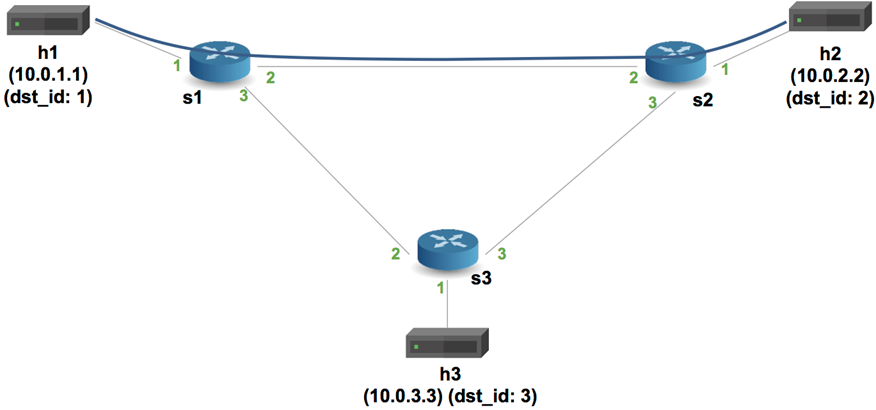
[Topology]
Based on https://github.com/p4lang/tutorials/tree/master/exercises/p4runtime, I change the mycontroller.py to let the h1 to send packets via path s1-s2 to h2 and switch to path s1-s3-s2. Each three seconds, the path changes again. (If you want to run the code, please download the p4runtime3.tar.gzhttps://nqucsie.myqnapcloud.com/smallko/sdn/p4runtime3.tar.gz)
[what I has done]
1. Change the file p4runtime3\p4runtime\switch.py (see the code in red. I add DeleteTableEntry method. Because when I need to change the path, I need to delete all rules that are already in the switches.)
|
2.
from abc import
abstractmethod 3.
4.
import grpc 5.
from p4 import p4runtime_pb2 6.
from p4.tmp import
p4config_pb2 7.
8.
class
SwitchConnection(object): 9.
def __init__(self,
name, address='127.0.0.1:50051', device_id=0): 10. self.name
= name 11. self.address
= address 12. self.device_id
= device_id 13. self.p4info
= None 14. self.channel
= grpc.insecure_channel(self.address) 15. self.client_stub
= p4runtime_pb2.P4RuntimeStub(self.channel) 16. 17.
self._reqs = [] 18. 19. @abstractmethod 20. def
buildDeviceConfig(self, **kwargs): 21. return
p4config_pb2.P4DeviceConfig() 22. 23. def
SetForwardingPipelineConfig(self, p4info, dry_run=False, **kwargs): 24. device_config
= self.buildDeviceConfig(**kwargs) 25. request
= p4runtime_pb2.SetForwardingPipelineConfigRequest() 26. request.device_id
= self.device_id 27. config
= request.config 28. config.p4info.CopyFrom(p4info) 29. config.p4_device_config
= device_config.SerializeToString() 30. request.action
= p4runtime_pb2.SetForwardingPipelineConfigRequest.VERIFY_AND_COMMIT 31. if
dry_run: 32. print
"P4 Runtime SetForwardingPipelineConfig:", request 33. else: 34. self.client_stub.SetForwardingPipelineConfig(request) 35. 36.
def DeleteTableEntry(self, dry_run=False): 37.
print
"DeleteTableEntry() is called, device_id=", self.device_id 38.
updates =
[] 39.
for
req in reversed(self._reqs): 40.
for
update in reversed(req.updates): 41.
if
update.type == p4runtime_pb2.Update.INSERT: 42.
updates.append(update) 43.
new_req
= p4runtime_pb2.WriteRequest() 44.
new_req.device_id =
self.device_id 45.
for
update in updates: 46.
update.type
= p4runtime_pb2.Update.DELETE 47.
new_req.updates.add().CopyFrom(update) 48.
if
dry_run: 49.
print
"P4 Runtime Write:", new_req 50.
else: 51.
self.client_stub.Write(new_req) 52. 53. def
WriteTableEntry(self, table_entry, dry_run=False): 54. request
= p4runtime_pb2.WriteRequest() 55. request.device_id
= self.device_id 56. update
= request.updates.add() 57. update.type
= p4runtime_pb2.Update.INSERT 58. update.entity.table_entry.CopyFrom(table_entry) 59. if
dry_run: 60. print
"P4 Runtime Write:", request 61. else: 62. self.client_stub.Write(request) 63. self._reqs.append(request) 64. 65. def
ReadTableEntries(self, table_id=None, dry_run=False): 66. request
= p4runtime_pb2.ReadRequest() 67. request.device_id
= self.device_id 68. entity
= request.entities.add() 69. table_entry
= entity.table_entry 70. if
table_id is not None: 71. table_entry.table_id
= table_id 72. else: 73. table_entry.table_id
= 0 74. if
dry_run: 75. print
"P4 Runtime Read:", request 76. else: 77. for
response in self.client_stub.Read(request): 78. #print
"response=", response 79. yield
response 80. 81. def
ReadCounters(self, counter_id=None, index=None, dry_run=False): 82. request
= p4runtime_pb2.ReadRequest() 83. request.device_id
= self.device_id 84. entity
= request.entities.add() 85. counter_entry
= entity.counter_entry 86. if
counter_id is not None: 87. counter_entry.counter_id
= counter_id 88. else: 89. counter_entry.counter_id
= 0 90. if
index is not None: 91. counter_entry.index
= index 92. if
dry_run: 93. print
"P4 Runtime Read:", request 94. else: 95. for
response in self.client_stub.Read(request): 96. yield response |
2. solution\mycontroller.py (add the code for path change)
|
#!/usr/bin/env python2 import argparse import os from time import sleep # NOTE: Appending to the PYTHON_PATH is only required
in the `solution` directory. # It is
not required for mycontroller.py in the top-level directory. import sys sys.path.append(os.path.join(os.path.dirname(__file__),
'..')) import p4runtime_lib.bmv2 import p4runtime_lib.helper SWITCH_TO_HOST_PORT = 1 SWITCH_TO_SWITCH_PORT = 2 SWITCH_TO_SWITCH_PORTs1tos3 = 3 SWITCH_TO_SWITCH_PORTs3tos1 = 2 SWITCH_TO_SWITCH_PORTh1toh2vias3_link1 = 3 SWITCH_TO_SWITCH_PORTh1toh2vias3_link2 = 3 SWITCH_TO_SWITCH_PORTh2toh1vias3_link1 = 3 SWITCH_TO_SWITCH_PORTh2toh1vias3_link2 = 2 def clearTunnelRule(p4info_helper, mysw): print "Clear rules on
%s" % mysw.name mysw.DeleteTableEntry() def writeTunnelRules3(p4info_helper,
ingress_sw, egress_sw, tunnel_id,
dst_eth_addr, dst_ip_addr, int_sw, myport1, myport2): table_entry =
p4info_helper.buildTableEntry(
table_name="MyIngress.ipv4_lpm",
match_fields={
"hdr.ipv4.dstAddr": (dst_ip_addr, 32) },
action_name="MyIngress.myTunnel_ingress",
action_params={
"dst_id": tunnel_id, })
ingress_sw.WriteTableEntry(table_entry) print "Installed
ingress tunnel rule on %s" % ingress_sw.name table_entry =
p4info_helper.buildTableEntry(
table_name="MyIngress.myTunnel_exact",
match_fields={
"hdr.myTunnel.dst_id": tunnel_id },
action_name="MyIngress.myTunnel_forward",
action_params={ "port":
myport1 })
ingress_sw.WriteTableEntry(table_entry) print "Installed
transit tunnel rule on %s" % ingress_sw.name table_entry =
p4info_helper.buildTableEntry(
table_name="MyIngress.myTunnel_exact",
match_fields={
"hdr.myTunnel.dst_id": tunnel_id },
action_name="MyIngress.myTunnel_forward",
action_params={
"port": myport2 })
int_sw.WriteTableEntry(table_entry) print "Installed
transit tunnel rule on %s" % int_sw.name table_entry =
p4info_helper.buildTableEntry(
table_name="MyIngress.myTunnel_exact",
match_fields={
"hdr.myTunnel.dst_id": tunnel_id },
action_name="MyIngress.myTunnel_egress",
action_params={
"dstAddr": dst_eth_addr,
"port": SWITCH_TO_HOST_PORT })
egress_sw.WriteTableEntry(table_entry) print "Installed
egress tunnel rule on %s" % egress_sw.name def writeTunnelRules2(p4info_helper,
ingress_sw, egress_sw, tunnel_id,
dst_eth_addr, dst_ip_addr, myport): # 1) Tunnel Ingress
Rule table_entry =
p4info_helper.buildTableEntry(
table_name="MyIngress.ipv4_lpm",
match_fields={
"hdr.ipv4.dstAddr": (dst_ip_addr, 32) },
action_name="MyIngress.myTunnel_ingress",
action_params={
"dst_id": tunnel_id, })
ingress_sw.WriteTableEntry(table_entry) print "Installed
ingress tunnel rule on %s" % ingress_sw.name # 2) Tunnel Transit Rule table_entry =
p4info_helper.buildTableEntry(
table_name="MyIngress.myTunnel_exact",
match_fields={
"hdr.myTunnel.dst_id": tunnel_id },
action_name="MyIngress.myTunnel_forward",
action_params={
"port": myport })
ingress_sw.WriteTableEntry(table_entry) print "Installed
transit tunnel rule on %s" % ingress_sw.name # 3) Tunnel Egress Rule table_entry =
p4info_helper.buildTableEntry(
table_name="MyIngress.myTunnel_exact",
match_fields={
"hdr.myTunnel.dst_id": tunnel_id },
action_name="MyIngress.myTunnel_egress",
action_params={
"dstAddr":
dst_eth_addr,
"port": SWITCH_TO_HOST_PORT })
egress_sw.WriteTableEntry(table_entry) print "Installed
egress tunnel rule on %s" % egress_sw.name def writeTunnelRules(p4info_helper, ingress_sw,
egress_sw, tunnel_id,
dst_eth_addr, dst_ip_addr):
'''
Installs three rules:
1) An tunnel ingress rule on the ingress switch in the ipv4_lpm table
that
encapsulates traffic into a tunnel with the specified ID
2) A transit rule on the ingress switch that forwards traffic based on the
specified ID
3) An tunnel egress rule on the egress switch that decapsulates
traffic with the
specified ID and sends it to the host
:param p4info_helper: the P4Info helper
:param ingress_sw: the ingress switch connection
:param egress_sw: the egress switch connection
:param tunnel_id: the specified tunnel ID
:param dst_eth_addr: the destination IP to match in the ingress rule
:param dst_ip_addr: the destination Ethernet address to write in the
egress rule
'''
# 1) Tunnel Ingress Rule
table_entry = p4info_helper.buildTableEntry(
table_name="MyIngress.ipv4_lpm",
match_fields={
"hdr.ipv4.dstAddr": (dst_ip_addr, 32) },
action_name="MyIngress.myTunnel_ingress",
action_params={
"dst_id": tunnel_id, })
ingress_sw.WriteTableEntry(table_entry)
print "Installed ingress tunnel rule on %s" %
ingress_sw.name
# 2) Tunnel Transit Rule
# The rule will need to be added to the myTunnel_exact table and match
on
# the tunnel ID (hdr.myTunnel.dst_id). Traffic will need to be
forwarded
# using the myTunnel_forward action on the port connected to the next
switch.
#
# For our simple topology, switch 1 and switch 2 are connected using a
# link attached to port 2 on both switches. We have defined a variable
at
# the top of the file, SWITCH_TO_SWITCH_PORT, that you can use as the
output
# port for this action.
#
# We will only need a transit rule on the ingress switch because we
are
# using a simple topology. In general, you'll need on transit rule for
# each switch in the path (except the last switch, which has the
egress rule),
# and you will need to select the port dynamically for each switch
based on
# your topology.
table_entry = p4info_helper.buildTableEntry(
table_name="MyIngress.myTunnel_exact",
match_fields={
"hdr.myTunnel.dst_id": tunnel_id },
action_name="MyIngress.myTunnel_forward",
action_params={
"port": SWITCH_TO_SWITCH_PORT })
ingress_sw.WriteTableEntry(table_entry)
print "Installed transit tunnel rule on %s" %
ingress_sw.name
# 3) Tunnel Egress Rule
# For our simple topology, the host will always be located on the
# SWITCH_TO_HOST_PORT (port 1).
# In general, you will need to keep track of which port the host is
# connected to.
table_entry = p4info_helper.buildTableEntry(
table_name="MyIngress.myTunnel_exact",
match_fields={
"hdr.myTunnel.dst_id": tunnel_id },
action_name="MyIngress.myTunnel_egress",
action_params={
"dstAddr": dst_eth_addr,
"port": SWITCH_TO_HOST_PORT })
egress_sw.WriteTableEntry(table_entry)
print "Installed egress tunnel rule on %s" % egress_sw.name def readTableRules(p4info_helper, sw):
'''
Reads the table entries from all tables on the switch.
:param p4info_helper: the P4Info helper
:param sw: the switch connection
'''
print '\n----- Reading tables rules for %s -----' % sw.name
for response in sw.ReadTableEntries():
for entity in response.entities:
entry = entity.table_entry
# TODO For extra credit, you can use the p4info_helper to translate
#
the IDs the entry to names
table_name = p4info_helper.get_tables_name(entry.table_id)
print '%s: ' % table_name,
for m in entry.match:
print p4info_helper.get_match_field_name(table_name, m.field_id),
print '%r' % (p4info_helper.get_match_field_value(m),),
action = entry.action.action
action_name = p4info_helper.get_actions_name(action.action_id)
print '->', action_name,
for p in action.params:
print p4info_helper.get_action_param_name(action_name, p.param_id),
print '%r' % p.value,
print def printCounter(p4info_helper, sw, counter_name,
index):
'''
Reads the specified counter at the specified index from the switch. In
our
program, the index is the tunnel ID. If the index is 0, it will return
all
values from the counter.
:param p4info_helper: the P4Info helper
:param sw: the switch
connection
:param counter_name: the name of the counter from the P4 program
:param index: the counter index (in our case, the tunnel ID)
'''
for response in
sw.ReadCounters(p4info_helper.get_counters_id(counter_name), index):
for entity in response.entities:
counter = entity.counter_entry
print "%s %s %d: %d packets (%d bytes)" % (
sw.name, counter_name, index,
counter.data.packet_count, counter.data.byte_count
) def main(p4info_file_path, bmv2_file_path):
# Instantiate a P4 Runtime helper from the p4info file
p4info_helper = p4runtime_lib.helper.P4InfoHelper(p4info_file_path)
# Create a switch connection object for s1 and s2;
# this is backed by a P4 Runtime gRPC connection
s1 = p4runtime_lib.bmv2.Bmv2SwitchConnection('s1',
address='127.0.0.1:50051',
device_id=0)
s2 = p4runtime_lib.bmv2.Bmv2SwitchConnection('s2',
address='127.0.0.1:50052',
device_id=1)
s3 =
p4runtime_lib.bmv2.Bmv2SwitchConnection('s3',
address='127.0.0.1:50053',
device_id=2)
# Install the P4 program on the switches
s1.SetForwardingPipelineConfig(p4info=p4info_helper.p4info,
bmv2_json_file_path=bmv2_file_path)
print "Installed P4 Program using SetForwardingPipelineConfig on
%s" % s1.name
s2.SetForwardingPipelineConfig(p4info=p4info_helper.p4info,
bmv2_json_file_path=bmv2_file_path)
print "Installed P4 Program using SetForwardingPipelineConfig on
%s" % s2.name
s3.SetForwardingPipelineConfig(p4info=p4info_helper.p4info,
bmv2_json_file_path=bmv2_file_path)
print "Installed P4 Program using SetForwardingPipelineConfig on
%s" % s3.name
# Write the rules that tunnel traffic from h1 to h2
#writeTunnelRules(p4info_helper, ingress_sw=s1, egress_sw=s2,
tunnel_id=100,
#
dst_eth_addr="00:00:00:00:02:02",
dst_ip_addr="10.0.2.2")
# Write the rules that tunnel traffic from h2 to h1
#writeTunnelRules(p4info_helper, ingress_sw=s2, egress_sw=s1,
tunnel_id=200,
#
dst_eth_addr="00:00:00:00:01:01", dst_ip_addr="10.0.1.1") # Write the
rules that tunnel traffic from h1 to h3
writeTunnelRules2(p4info_helper, ingress_sw=s1, egress_sw=s3,
tunnel_id=300,
dst_eth_addr="00:00:00:00:03:03",
dst_ip_addr="10.0.3.3", myport=SWITCH_TO_SWITCH_PORTs1tos3 ) # Write the rules that
tunnel traffic from h3 to h1
writeTunnelRules2(p4info_helper, ingress_sw=s3, egress_sw=s1,
tunnel_id=400,
dst_eth_addr="00:00:00:00:01:01",
dst_ip_addr="10.0.1.1", myport=SWITCH_TO_SWITCH_PORTs3tos1 ) #Write the rules that
tunnel traffic from h1 to h2 via s1-s3-s2
writeTunnelRules3(p4info_helper, ingress_sw=s1, egress_sw=s2,
tunnel_id=500,
dst_eth_addr="00:00:00:00:02:02",
dst_ip_addr="10.0.2.2", int_sw=s3, myport1=3, myport2=3) #Write the rules that
tunnel traffic from h2 to h1 via s2-s3-s1
writeTunnelRules3(p4info_helper, ingress_sw=s2, egress_sw=s1,
tunnel_id=600,
dst_eth_addr="00:00:00:00:01:01",
dst_ip_addr="10.0.1.1", int_sw=s3, myport1=3, myport2=2)
# TODO Uncomment the following two lines to read table entries from s1
and s2
readTableRules(p4info_helper, s1)
readTableRules(p4info_helper, s2)
readTableRules(p4info_helper, s3)
i=1
try:
while True:
i=(i+1)%2
print "i=", i
if i==0:
clearTunnelRule(p4info_helper, mysw=s1)
clearTunnelRule(p4info_helper, mysw=s2)
clearTunnelRule(p4info_helper, mysw=s3)
print "h1 to h2 via s1-s2"
writeTunnelRules(p4info_helper, ingress_sw=s1, egress_sw=s2,
tunnel_id=100,
dst_eth_addr="00:00:00:00:02:02",
dst_ip_addr="10.0.2.2")
writeTunnelRules(p4info_helper, ingress_sw=s2, egress_sw=s1,
tunnel_id=200,
dst_eth_addr="00:00:00:00:01:01",
dst_ip_addr="10.0.1.1")
elif i==1:
clearTunnelRule(p4info_helper, mysw=s1)
clearTunnelRule(p4info_helper, mysw=s2)
clearTunnelRule(p4info_helper, mysw=s3)
print "h1 to h2 via s1-s3-s2"
writeTunnelRules3(p4info_helper, ingress_sw=s1, egress_sw=s2,
tunnel_id=500,
dst_eth_addr="00:00:00:00:02:02",
dst_ip_addr="10.0.2.2", int_sw=s3, myport1=3, myport2=3)
writeTunnelRules3(p4info_helper, ingress_sw=s2, egress_sw=s1,
tunnel_id=600,
dst_eth_addr="00:00:00:00:01:01",
dst_ip_addr="10.0.1.1", int_sw=s3, myport1=3, myport2=2)
sleep(3)
#print '\n----- Reading tunnel counters -----'
#printCounter(p4info_helper, s1,
"MyIngress.ingressTunnelCounter", 100)
#printCounter(p4info_helper, s2,
"MyIngress.egressTunnelCounter", 100)
#printCounter(p4info_helper, s2,
"MyIngress.ingressTunnelCounter", 200)
#printCounter(p4info_helper, s1,
"MyIngress.egressTunnelCounter", 200)
except KeyboardInterrupt:
print " Shutting down." if __name__ == '__main__':
parser = argparse.ArgumentParser(description='P4Runtime Controller')
parser.add_argument('--p4info', help='p4info proto in text format from
p4c',
type=str, action="store", required=False,
default='./build/advanced_tunnel.p4info')
parser.add_argument('--bmv2-json', help='BMv2 JSON file from p4c',
type=str, action="store", required=False,
default='./build/advanced_tunnel.json')
args = parser.parse_args()
if not os.path.exists(args.p4info):
parser.print_help()
print "\np4info file not found: %s\nHave you run 'make'?" %
args.p4info
parser.exit(1)
if not os.path.exists(args.bmv2_json):
parser.print_help()
print
"\nBMv2 JSON file not found: %s\nHave you run 'make'?" %
args.bmv2_json
parser.exit(1)
main(args.p4info, args.bmv2_json) |
[Execution]
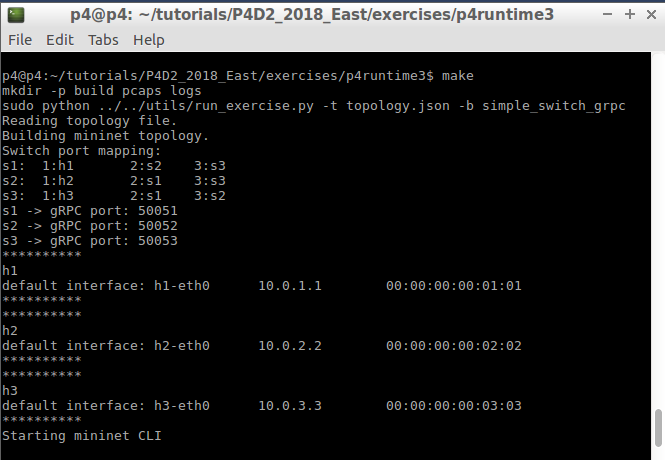
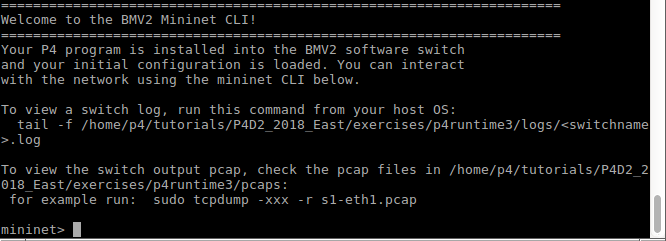
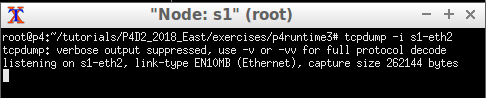
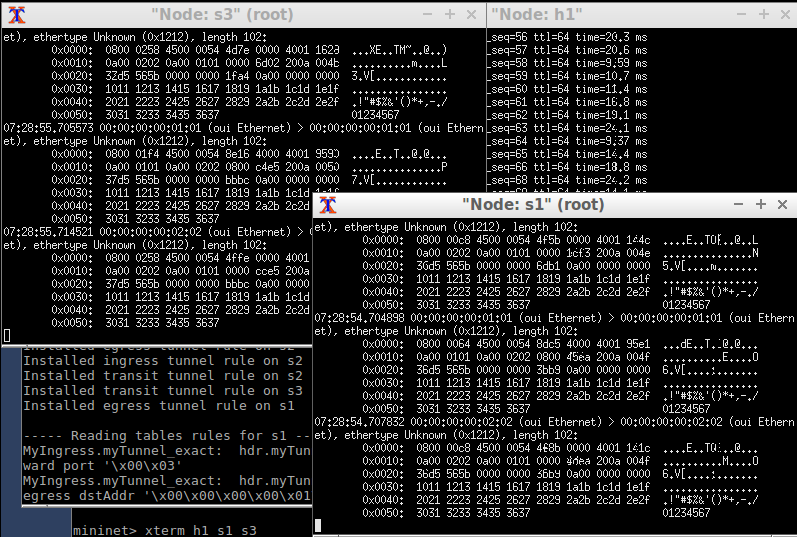
Use “xterm h1 s1 s3” to open three terminals. H1 will send ping packets to H2. S1 will capture packets from s1-eth2 to see whether packets go through from s1 to s2. S3 will capture packets from s3-eth3 to see whether packets go through from s3 to s2.
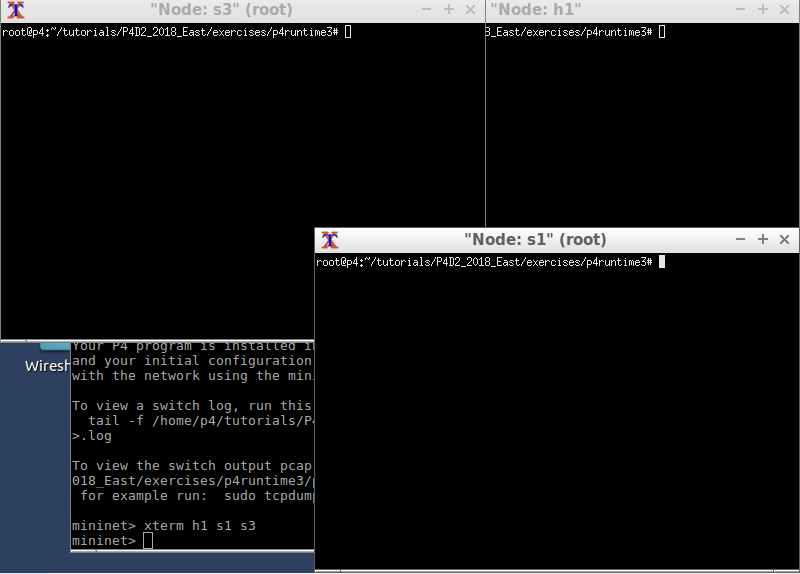

H1 ping h2. It does not work. Because we don’t run the controller.

Start another terminal (not from mininet terminal).
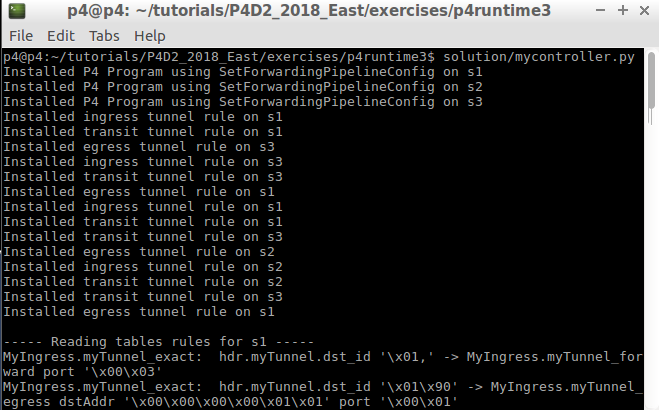
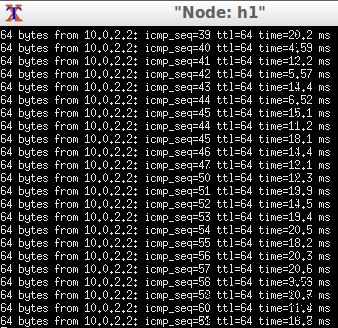
Now we can see ping works.
We can also see that packets can be captured in s1-eth2 and s3-eth3. (via two different paths.)
[reference]
1. https://github.com/p4lang/PI/blob/master/proto/ptf/base_test.py
2. https://cs344-stanford.github.io/deliverables/p4-mininet/
3. https://github.com/p4lang/tutorials
Dr. Chih-Heng Ke (smallko@gmail.com)
Department of Computer Science and Information
Engineering,
National Quemoy University, Kinmen, Taiwan.