P4 switch (P4-16): clone3() and mirroring_add example
[Topology]
H1-s1-H2
|
H3
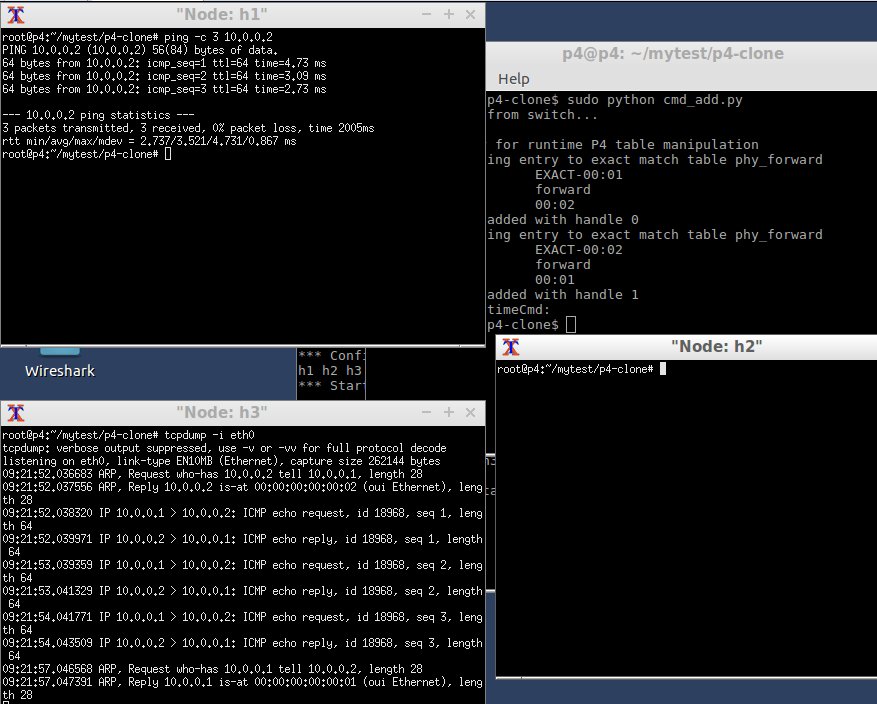
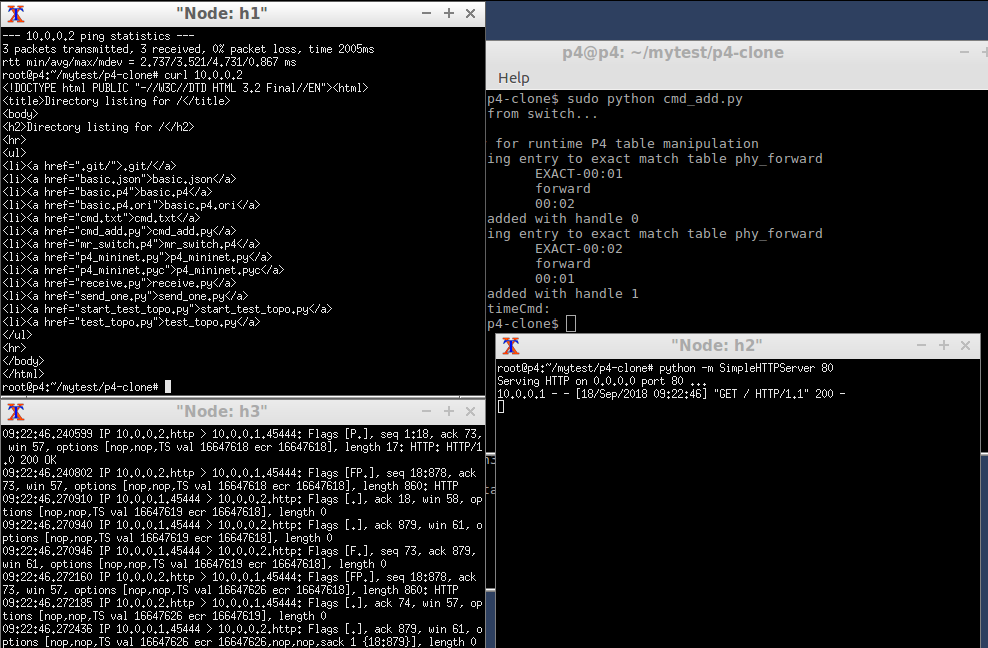
When h1 communicates with h2, the s1 will copy the packets and sends them to H3.
[basic.p4]
|
#include <core.p4> #include <v1model.p4> const bit<16> TYPE_IPV4 = 0x800; typedef bit<9> egressSpec_t; typedef bit<48> macAddr_t; typedef bit<32> ip4Addr_t; struct intrinsic_metadata_t { bit<4> mcast_grp; bit<4> egress_rid; bit<16> mcast_hash; bit<32> lf_field_list; } header ethernet_t { bit<48> dstAddr; bit<48> srcAddr; bit<16> etherType; } header ipv4_t { bit<4> version; bit<4> ihl; bit<8> diffserv; bit<16> totalLen; bit<16> identification; bit<3> flags; bit<13> fragOffset; bit<8> ttl; bit<8> protocol; bit<16> hdrChecksum; ip4Addr_t srcAddr; ip4Addr_t dstAddr; } struct metadata { @name(".intrinsic_metadata") intrinsic_metadata_t intrinsic_metadata; } struct headers { @name(".ethernet") ethernet_t ethernet; @name(".ipv4") ipv4_t ipv4; } parser ParserImpl(packet_in packet, out headers hdr, inout metadata meta, inout standard_metadata_t standard_metadata) { @name(".start") state start { transition parse_ethernet; } @name(".parse_ethernet") state parse_ethernet { packet.extract(hdr.ethernet); transition select(hdr.ethernet.etherType) { TYPE_IPV4: parse_ipv4; default: accept; } } @name(".parse_ipv4")state parse_ipv4 { packet.extract(hdr.ipv4); transition accept; } } control ingress(inout headers hdr, inout metadata meta, inout standard_metadata_t standard_metadata) {
action drop() { mark_to_drop(); }
action forward(egressSpec_t port) { standard_metadata.egress_spec = port; }
table phy_forward { key = { standard_metadata.ingress_port: exact; } actions = { forward; drop; } size = 1024; default_action = drop(); } @name(".do_copy") action do_copy() { clone3(CloneType.I2E,
(bit<32>)32w250, { standard_metadata }); } @name(".mycopy") table mycopy { actions = { do_copy; } size = 1; default_action = do_copy(); } apply { mycopy.apply(); phy_forward.apply(); } } control egress(inout headers hdr, inout metadata meta, inout standard_metadata_t standard_metadata) { apply { } } control DeparserImpl(packet_out packet, in headers hdr) { apply { packet.emit(hdr.ethernet); packet.emit(hdr.ipv4); } } control verifyChecksum(inout headers hdr, inout metadata meta) { apply { } } control computeChecksum(inout headers hdr, inout metadata meta) { apply { } } V1Switch(ParserImpl(), verifyChecksum(), ingress(), egress(), computeChecksum(), DeparserImpl()) main; |
[test_topo.py]
|
import os from mininet.net import Mininet from mininet.topo import Topo from mininet.log import setLogLevel, info from mininet.cli import CLI from mininet.node import RemoteController from p4_mininet import P4Switch, P4Host import argparse from time import sleep parser = argparse.ArgumentParser(description='Mininet demo') parser.add_argument('--behavioral-exe', help='Path to behavioral executable', type=str, action="store", required=False, default='simple_switch' ) parser.add_argument('--thrift-port', help='Thrift server port for table updates', type=int, action="store", default=9090) parser.add_argument('--num-hosts', help='Number of hosts to connect to switch', type=int, action="store", default=2) parser.add_argument('--mode', choices=['l2', 'l3'], type=str, default='l3') parser.add_argument('--json', help='Path to JSON config file', type=str, action="store", required=True) parser.add_argument('--pcap-dump', help='Dump packets on interfaces to pcap files', type=str, action="store", required=False, default=False) args = parser.parse_args() class SingleSwitchTopo(Topo): def __init__(self, sw_path, json_path, thrift_port, pcap_dump, **opts): Topo.__init__(self, **opts) switch1 =
self.addSwitch('s1', sw_path = sw_path, json_path = json_path, thrift_port =
thrift_port,cls = P4Switch ,pcap_dump = pcap_dump)
host1 = self.addHost('h1', mac = '00:00:00:00:00:01')
host2 = self.addHost('h2', mac = '00:00:00:00:00:02')
host3 = self.addHost('h3', mac = '00:00:00:00:00:03')
self.addLink(host1, switch1, port1 = 0, port2 = 1)
self.addLink(host2, switch1, port1 = 0, port2 = 2)
self.addLink(host3, switch1, port1 = 0, port2 = 3)
def main(): topo = SingleSwitchTopo(args.behavioral_exe, args.json, args.thrift_port, args.pcap_dump) #controller1 = RemoteController('controller1', ip = '10.108.148.148') net = Mininet(topo = topo, host = P4Host, controller = None) net.start() sleep(1) print('\033[0;32m'), print "Gotcha!" print('\033[0m') CLI(net) try: net.stop() except: print('\033[0;31m'), print('Stop error! Trying sudo mn -c') print('\033[0m') os.system('sudo mn -c') print('\033[0;32m'), print ('Stop successfully!') print('\033[0m') if __name__ == '__main__': setLogLevel('info') main() |
[start_test_topo.py]
|
import os os.system("sudo python test_topo.py --behavioral-exe /home/vagrant/behavioral-model/targets/simple_switch/simple_switch --json basic.json") |
[cmd.txt]
|
table_add phy_forward forward 1 => 2 table_add phy_forward forward 2 => 1 mirroring_add 250 3 |
[cmd_add.py]
|
import os os.system('sudo /home/vagrant/behavioral-model/targets/simple_switch/simple_switch_CLI --thrift-port=9090 < cmd.txt') |
[p4_mininet.py]
|
# Copyright 2013-present Barefoot Networks, Inc. # # Licensed under the Apache License, Version 2.0 (the "License"); # you may not use this file except in compliance with the License. # You may obtain a copy of the License at # # http://www.apache.org/licenses/LICENSE-2.0 # # Unless required by applicable law or agreed to in writing, software # distributed under the License is distributed on an "AS IS" BASIS, # WITHOUT WARRANTIES OR CONDITIONS OF ANY KIND, either express or implied. # See the License for the specific language governing permissions and # limitations under the License. # from mininet.net import Mininet from mininet.node import Switch, Host from mininet.log import setLogLevel, info, error, debug from mininet.moduledeps import pathCheck from sys import exit import os import tempfile import socket class P4Host(Host): def config(self, **params): r = super(Host, self).config(**params) self.defaultIntf().rename("eth0") for off in ["rx", "tx", "sg"]: cmd = "/sbin/ethtool --offload eth0 %s off" % off self.cmd(cmd) # disable IPv6 self.cmd("sysctl -w net.ipv6.conf.all.disable_ipv6=1") self.cmd("sysctl -w net.ipv6.conf.default.disable_ipv6=1") self.cmd("sysctl -w net.ipv6.conf.lo.disable_ipv6=1") return r def describe(self): print "**********" print self.name print "default interface: %s\t%s\t%s" %( self.defaultIntf().name, self.defaultIntf().IP(), self.defaultIntf().MAC() ) print "**********" class P4Switch(Switch): """P4 virtual switch""" device_id = 0 def __init__(self, name, sw_path = None, json_path = None, thrift_port = None, pcap_dump = False, log_console = False, verbose = False, device_id = None, enable_debugger = False, **kwargs): Switch.__init__(self, name, **kwargs) assert(sw_path) assert(json_path) # make sure that the provided sw_path is valid pathCheck(sw_path) # make sure that the provided JSON file exists if not os.path.isfile(json_path): error("Invalid JSON file.\n") exit(1) self.sw_path = sw_path self.json_path = json_path self.verbose = verbose logfile = "/tmp/p4s.{}.log".format(self.name) self.output = open(logfile, 'w') self.thrift_port = thrift_port self.pcap_dump = pcap_dump self.enable_debugger = enable_debugger self.log_console = log_console if device_id is not None: self.device_id = device_id P4Switch.device_id = max(P4Switch.device_id, device_id) else: self.device_id = P4Switch.device_id P4Switch.device_id += 1 self.nanomsg = "ipc:///tmp/bm-{}-log.ipc".format(self.device_id) @classmethod def setup(cls): pass def check_switch_started(self, pid): """While the process is running (pid exists), we check if the Thrift server has been started. If the Thrift server is ready, we assume that the switch was started successfully. This is only reliable if the Thrift server is started at the end of the init process""" while True: if not os.path.exists(os.path.join("/proc", str(pid))): return False sock = socket.socket(socket.AF_INET, socket.SOCK_STREAM) sock.settimeout(0.5) result = sock.connect_ex(("localhost", self.thrift_port)) if result == 0: return True def start(self, controllers): "Start up a new P4 switch" info("Starting P4 switch {}.\n".format(self.name)) args = [self.sw_path] for port, intf in self.intfs.items(): if not intf.IP(): args.extend(['-i', str(port) + "@" + intf.name]) #wuwzhs edit in 2017/11/10 #args.extend(['-i 3@veth1']) if self.pcap_dump: args.append("--pcap") # args.append("--useFiles") if self.thrift_port: args.extend(['--thrift-port', str(self.thrift_port)]) if self.nanomsg: args.extend(['--nanolog', self.nanomsg]) args.extend(['--device-id', str(self.device_id)]) P4Switch.device_id += 1 args.append(self.json_path) if self.enable_debugger: args.append("--debugger") if self.log_console: args.append("--log-console") logfile = "/tmp/p4s.{}.log".format(self.name) info(' '.join(args) + "\n") pid = None with tempfile.NamedTemporaryFile() as f: # self.cmd(' '.join(args) + ' > /dev/null 2>&1 &') self.cmd(' '.join(args) + ' >' + logfile + ' 2>&1 & echo $! >> ' + f.name) pid = int(f.read()) debug("P4 switch {} PID is {}.\n".format(self.name, pid)) if not self.check_switch_started(pid): error("P4 switch {} did not start correctly.\n".format(self.name)) exit(1) info("P4 switch {} has been started.\n".format(self.name)) def stop(self): "Terminate P4 switch." self.output.flush() self.cmd('kill %' + self.sw_path) self.cmd('wait') self.deleteIntfs() def attach(self, intf): "Connect a data port" assert(0) def detach(self, intf): "Disconnect a data port" assert(0) |
[Execution]
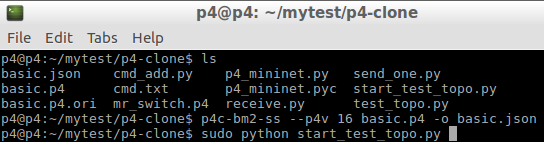
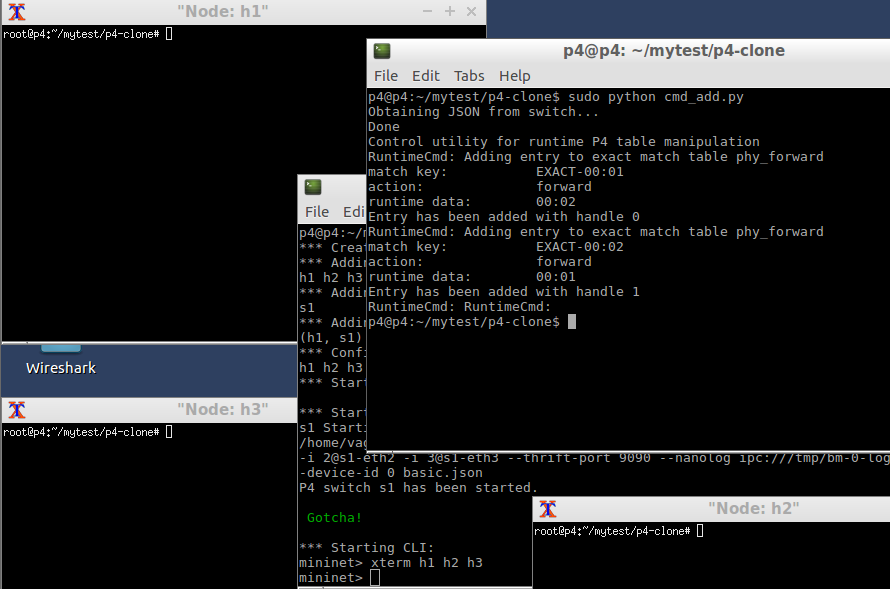
Ping Tests
Http Tests
(updated: 2020/6/18)
[topology]
H1------s1-------s2------H2
IP for H1: 10.0.1.1
IP for H2: 10.0.2.2
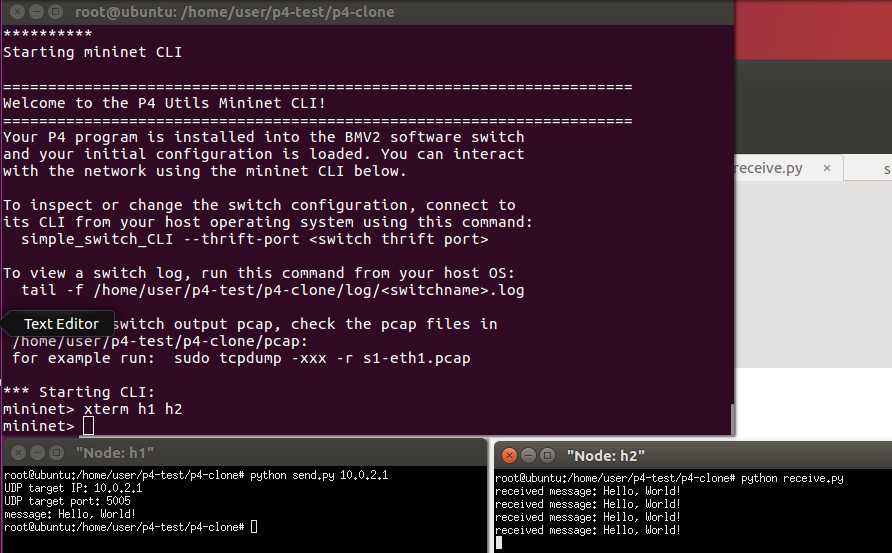
When h1 sends a packet to H2, s1, s2 will duplicate the packet that is destined for H2.
So one packet sent from h1 and H2 will get 4 packets. (S1 will receive one packet and send out 2 packets. S2 receives two packets and sends out four packets.)
[ip_forward.p4]
|
#include
<core.p4> #include
<v1model.p4> typedef
bit<48> macAddr_t; typedef
bit<9> egressSpec_t; header
ethernet_t { bit<48> dstAddr; bit<48> srcAddr; bit<16> etherType; } header
ipv4_t { bit<4> version; bit<4> ihl; bit<8> diffserv; bit<16> totalLen; bit<16>
identification; bit<3> flags; bit<13> fragOffset; bit<8> ttl; bit<8> protocol; bit<16> hdrChecksum; bit<32> srcAddr; bit<32> dstAddr; } struct
metadata { } struct
headers {
@name(".ethernet") ethernet_t ethernet; @name(".ipv4") ipv4_t ipv4; } parser
ParserImpl(packet_in packet, out headers hdr, inout metadata meta, inout
standard_metadata_t standard_metadata) {
@name(".parse_ethernet") state parse_ethernet {
packet.extract(hdr.ethernet);
transition select(hdr.ethernet.etherType) {
16w0x800: parse_ipv4;
default: accept; } }
@name(".parse_ipv4") state parse_ipv4 {
packet.extract(hdr.ipv4);
transition accept; } @name(".start")
state start {
transition parse_ethernet; } } control
egress(inout headers hdr, inout metadata meta, inout standard_metadata_t
standard_metadata) { apply { if
(hdr.ipv4.isValid() && hdr.ipv4.dstAddr==0x0a000201 &&
standard_metadata.instance_type == 0){ clone(CloneType.E2E,
(bit<32>)32w100);
} } } control
ingress(inout headers hdr, inout metadata meta, inout standard_metadata_t
standard_metadata) {
@name(".set_nhop") action set_nhop(macAddr_t dstAddr,
egressSpec_t port) {
//set the src mac address as the previous dst, this is not correct
right?
hdr.ethernet.srcAddr = hdr.ethernet.dstAddr;
//set the destination mac address that we got from the match in the
table
hdr.ethernet.dstAddr = dstAddr;
//set the output port that we also get from the table
standard_metadata.egress_spec = port;
//decrease ttl by 1
hdr.ipv4.ttl = hdr.ipv4.ttl - 1; } @name("._drop")
action _drop() {
mark_to_drop(standard_metadata); }
@name(".ipv4_lpm") table ipv4_lpm {
actions = {
set_nhop;
_drop; } key
= {
hdr.ipv4.dstAddr: lpm; }
size = 512;
const default_action = _drop(); } apply { if
(hdr.ipv4.isValid()) {
ipv4_lpm.apply(); } } } control
DeparserImpl(packet_out packet, in headers hdr) { apply {
packet.emit(hdr.ethernet);
packet.emit(hdr.ipv4); } } control
verifyChecksum(inout headers hdr, inout metadata meta) { apply {
verify_checksum(true, { hdr.ipv4.version, hdr.ipv4.ihl,
hdr.ipv4.diffserv, hdr.ipv4.totalLen, hdr.ipv4.identification,
hdr.ipv4.flags, hdr.ipv4.fragOffset, hdr.ipv4.ttl, hdr.ipv4.protocol,
hdr.ipv4.srcAddr, hdr.ipv4.dstAddr }, hdr.ipv4.hdrChecksum,
HashAlgorithm.csum16); } } control
computeChecksum(inout headers hdr, inout metadata meta) { apply {
update_checksum(true, { hdr.ipv4.version, hdr.ipv4.ihl,
hdr.ipv4.diffserv, hdr.ipv4.totalLen, hdr.ipv4.identification,
hdr.ipv4.flags, hdr.ipv4.fragOffset, hdr.ipv4.ttl, hdr.ipv4.protocol,
hdr.ipv4.srcAddr, hdr.ipv4.dstAddr }, hdr.ipv4.hdrChecksum,
HashAlgorithm.csum16); } } V1Switch(ParserImpl(),
verifyChecksum(), ingress(), egress(), computeChecksum(), DeparserImpl())
main; |
[cmd.txt]
|
table_add
ipv4_lpm set_nhop 10.0.1.1/32 => 00:00:0a:00:01:01 1 table_add
ipv4_lpm set_nhop 10.0.2.1/32 => 00:02:00:00:00:00 2 mirroring_add
100 2 |
[cmd2.txt]
|
table_add
ipv4_lpm set_nhop 10.0.1.1/32 => 00:01:00:00:00:00 1 table_add
ipv4_lpm set_nhop 10.0.2.1/32 => 00:00:0a:00:02:01 2 mirroring_add
100 2 |
[p4app.json]
|
{ "program":
"ip_forward.p4", "switch":
"simple_switch", "compiler": "p4c", "options": "--target
bmv2 --arch v1model --std p4-16", "switch_cli":
"simple_switch_CLI", "cli": true, "pcap_dump": true, "enable_log": true, "topo_module": { "file_path":
"", "module_name":
"p4utils.mininetlib.apptopo", "object_name":
"AppTopoStrategies" }, "controller_module": null, "topodb_module": { "file_path":
"", "module_name":
"p4utils.utils.topology", "object_name":
"Topology" }, "mininet_module": { "file_path":
"", "module_name":
"p4utils.mininetlib.p4net", "object_name":
"P4Mininet" }, "topology": {
"assignment_strategy": "manual",
"auto_arp_tables": "true", "auto_gw_arp":
"true", "links":
[["h1", "s1"], ["s1", "s2"],
["s2", "h2"]], "hosts": {
"h1": {
"ip": "10.0.1.1/24",
"gw": "10.0.1.254" },
"h2": {
"ip": "10.0.2.1/24",
"gw": "10.0.2.254" } }, "switches": {
"s1": {
"cli_input": "cmd.txt",
"program": "ip_forward.p4" },
"s2": {
"cli_input": "cmd2.txt",
"program": "ip_forward.p4" } } } } |
[send.py]
|
import
socket,sys UDP_IP
= sys.argv[1] UDP_PORT
= 5005 MESSAGE
= "Hello, World!" print
"UDP target IP:", UDP_IP print
"UDP target port:", UDP_PORT print
"message:", MESSAGE sock
= socket.socket(socket.AF_INET, # Internet
socket.SOCK_DGRAM) # UDP sock.sendto(MESSAGE,
(UDP_IP, UDP_PORT)) |
[receive.py]
|
import
socket UDP_IP
= "0.0.0.0" UDP_PORT
= 5005 sock
= socket.socket(socket.AF_INET, # Internet
socket.SOCK_DGRAM) # UDP sock.bind((UDP_IP,
UDP_PORT)) while
True: data, addr =
sock.recvfrom(1024) # buffer size is 1024 bytes print "received
message:", data |
[execution]
Dr. Chih-Heng Ke (smallko@gmail.com)
Department of Computer Science and Information
Engineering,
National Quemoy University, Kinmen, Taiwan.