One PC Two Interfaces: one send and one receive
[topology]
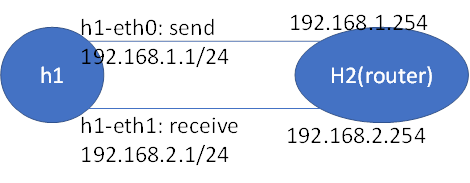
Note. With this setting, we don’t need to care about the time synchronization. We can use this topology to test the routing performance of H2.
[test.py]
|
#!/usr/bin/env python from mininet.cli
import CLI from mininet.net import Mininet from mininet.link import Link,TCLink,Intf if '__main__' == __name__:
net = Mininet(link=TCLink)
h1 = net.addHost('h1')
h2 = net.addHost('h2')
Link(h1, h2)
Link(h1, h2)
net.build()
h2.cmd('ifconfig h2-eth0 192.168.1.254
netmask 255.255.255.0')
h2.cmd('ifconfig h2-eth1 192.168.2.254
netmask 255.255.255.0')
h2.cmd('ifconfig h2-eth0 hw
ether 00:00:00:00:02:00')
h2.cmd('ifconfig h2-eth1 hw
ether 00:00:00:00:02:01')
h2.cmd("echo 1 > /proc/sys/net/ipv4/ip_forward")
h1.cmd("ifconfig h1-eth0 0")
h1.cmd("ifconfig h1-eth1 0")
h1.cmd("ifconfig h1-eth0 192.168.1.1
netmask 255.255.255.0")
h1.cmd("ifconfig h1-eth1 192.168.2.1
netmask 255.255.255.0")
h1.cmd('ifconfig h1-eth0 hw
ether 00:00:00:00:01:00')
h1.cmd('ifconfig h1-eth1 hw
ether 00:00:00:00:01:01')
h1.cmd("route add -host 192.168.2.1 gw
192.168.1.254 h1-eth0")
h1.cmd("route add -host 192.168.1.1 gw
192.168.2.254 h1-eth1")
CLI(net) net.stop() |
[send.py]
|
#!/usr/bin/env python import argparse import sys import socket import random import struct import datetime from scapy.all
import sendp, send, get_if_list,
get_if_hwaddr from scapy.all
import Packet from scapy.all
import Ether, IP, UDP, TCP def main(): if len(sys.argv)<3:
print 'pass 2 arguments: <destination>
"<message>"' exit(1) addr
= socket.gethostbyname(sys.argv[1]) iface
= "h1-eth0" print "sending on
interface %s to %s" % (iface, str(addr)) pkt = Ether(src=get_if_hwaddr(iface)) pkt = pkt /IP(dst=addr)
/ TCP(dport=1234, sport=random.randint(49152,65535))
/ sys.argv[2] pkt.show2() print datetime.datetime.now() sendp(pkt, iface=iface, verbose=False) if __name__ == '__main__': main() |
[receive.py]
|
#!/usr/bin/env python import sys import struct import os import datetime from scapy.all
import sniff, sendp, hexdump,
get_if_list, get_if_hwaddr,
bind_layers from scapy.all
import Packet, IPOption, Ether from scapy.all
import ShortField, IntField,
LongField, BitField, FieldListField, FieldLenField from scapy.all
import IP, UDP, TCP, Raw, ls from scapy.layers.inet import _IPOption_HDR def handle_pkt(pkt): print "Controller got
a packet" if TCP in pkt: print datetime.datetime.now() print pkt.summary() def main(): if len(sys.argv) < 2: iface = 'h1-eth1' else: iface = sys.argv[1] print "sniffing on
%s" % iface sys.stdout.flush() sniff(iface = iface,
prn = lambda x: handle_pkt(x)) if __name__ == '__main__': main() |
[execution]

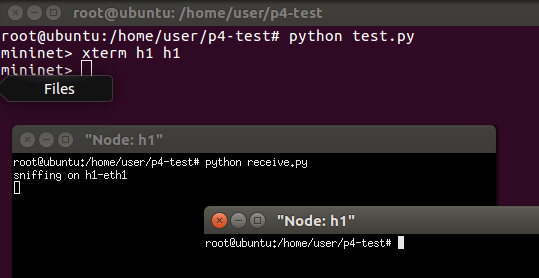
Open two terminals. One for send and the other for receive.
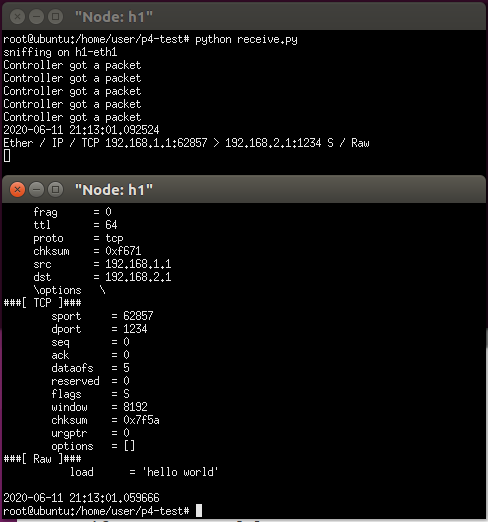
We got the sending and receiving time. Then we can obtain the time difference for transmission delays and the packet processing delay in h2.
Dr. Chih-Heng Ke (smallko@gmail.com)
Department of Computer Science and Information
Engineering,
National Quemoy University, Kinmen, Taiwan.